2026 Reviews - Trouble in Twin Lakes
Over the past few years I've been running quite a bit of Cairn, especially with the release of the game's second edition, and while I've pretty much lost track of most of the third-party adventures, I've definitely been enjoying the piecemeal release of the "Cairn Adventure Series", which this review will return to. I've previously reviewed the second entry in the series, but the first one was the second one I got my hands on. Everyone up to speed? Onto the review of "Trouble in Twin Lakes".
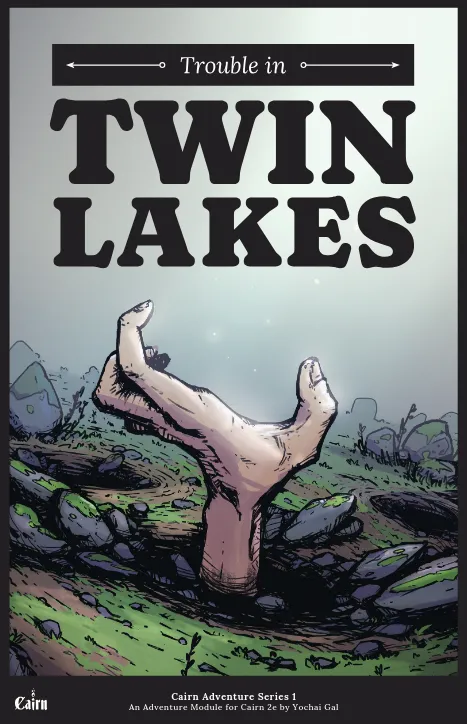
This adventure was written by Yochai Gal, with art by Ari-Matti Toivonen. It was designed for use with Cairn, naturally, and that is the system that I ran it with-- this particular group was a mix of new and old characters who had survived previous adventures.
The general premise is a slight twist on the "town with a problem" trope-- for the most part, this particular town doesn't exactly realize that it has a problem yet. Two different people involved with the town have disappeared in recent weeks, and while some people suspect that the disappearances are connected, they're really both clues that lead to two different plots which the players may investigate. In one instance, an ancient evil is attempting to recover her strength by consuming human hearts, and in the other a witch is seeking to power up a relic in the hopes of ripping open a gate to the Roots which will unleash untold havoc on the surrounding area. In both cases, the potential problem will only get worse over time if the PCs do not intervene in some way.
Getting it to the Table
One thing I really enjoy about adventures that Yochai is written is that he pays a tremendous amount of attention to smart layout that strives to make the adventure easy to run straight from the book. He has definitely done that here, and there is a great deal of useful information efficiently presented in about 22 pages including two full-page maps.
Opening with a spread of background and recent events leading up to the adventure, we're given a good baseline for what is really happening (including the classic "What's Really Going On Here?" heading), and we are also given the timeline for each of the problems. The witch's plot will mature at the next full moon (two days away), and the ancient evil (Vuk, the lich queen) is a much more imminent danger in that it results in additional townsfolk disappearing-- one heart has already been consumed and she only needs two more. There is a handy little table of potential victims to go with the timeline/procedure for advancing her plot.
Next we have a roster of "Important NPCs", each with their own list of bullet points indicating what they know and how they will interact with other NPCs and the PCs. Also included in this section are certain important facts that can be uncovered as the PCs investigate the events happening in the town. Following this is an overview of the region where Isthmus Town is located, along with some rumors and random encounters that occur when PCs are traveling around the lakes.
Much of the remaining pages are devoted to descriptions of the various areas that PCs can explore, including the dungeon sunken beneath The Downs. Each of these areas is presented in a very terse and precise manner with nested bullet points indicating what can be discovered through further investigation. Where appropriate, hazards and monsters that might be encountered have their stat blocks included for ease of reference. New relics are also detailed where they are found, and they are also collected and reprinted in an appendix at the end of the booklet. Overall, this section is very clean and efficient and is a perfect example of this kind of concise keying that really makes it simple for a GM to pick up and run the game with minimal prep. That said, a certain amount of prep is needed-- more on that later.
The dungeon itself was an interesting change of pace from what began as a fairly straightforward investigative adventure, which in itself was a nice change of pace from the things that I usually run. There is plenty of interactivity baked into the dungeon, with lots of opportunity for smart planning and alternate routes when one became too dangerous due to the wandering monsters that could be awoken. I also enjoyed the fact that there were really no questions answered about the significance of this dungeon; it remains an enigma that could easily be turned into hooks for further play outside the scope of the adventure.
What Worked?
- Clean and efficient layout. You don't need to sift through a wall of text to find the relevant information that you need to run the adventure; it's picked out with bullet points and clearly presented.
- Interesting situations. There is really no hand-holding for the players-- they're given a hook that gets them to come to the town, and nearly every NPC they talk to leads them to new locations and opportunities to uncover more answers to the questions posed by the situations.
- Evolving problems. I always enjoy a "what happens if the players do nothing" kind of approach to adventure design, and this gives us two separate problems that are each on their own track.
What Didn't Work?
- Separate situations sometimes stay separate. When I ran this for my players, I used the hook that had them looking for Jandy, a missing tithe collector who had been seen sinking into quicksand near the old mill. After speaking to the townsfolk and learning of this, they immediately investigated the mill and rescued Jandy (through some excellent planning and smart use of a spellbook), and could very easily have simply returned to the town, recovered the tithe, and sent Jandy back on his way and then claim their reward. They would have "completed" the adventure according to their hook and could very easily have missed the disappearance of Aldra entirely. I would recommend anyone running the adventure to prepare some additional interactions with other townsfolk to increase the odds that the PCs will learn about Aldra's fate (or Jandy's if they've followed the other hook)
- Details in different places. This was a minor issue, but I did have to do a lot of flipping back and forth between the area descriptions and the NPC section because while the location key included the places where events in the mystery happened, the actual events themselves were described in in the NPCs' bullet points. I'm not sure how I would have done this differently, however, as keeping them all together would probably have encroached on "wall of text" territory. I feel this is always a challenge with an investigation type adventure, because often you really do need a lot of information at hand that will probably be approached in an unexpected way based on how your players decide to act.
Final Thoughts
Overall this was an intriguing adventure to let my players loose in, especially once I shook things up a bit and gave things a little nudge to keep them in town after they had ostensibly "completed" their part of the adventure.
You can get the PDF of "Trouble in Twin Lakes" for free on Yochai's itch.io page. Thanks for reading!