2026 Reviews - Building Better Worlds: Part 1
To my horror, I realize that 2026 is well over halfway done, while somehow also feeling like it's been about three years long. I figure it's once again time to write about some of the gaming that I've been doing this year. I returned to Alien RPG and tried a longer form campaign instead of a one shot like I have done previously.
I picked up the Building Better Worlds campaign book a while ago with the intention of simply mining it for procedures for an Alien campaign, hoping that it would be something like the procedures found in Traveller or other sandboxy games. I ended up being disappointed with the actual procedures, since they took up a small percentage of the book with the rest being given over to a pre-written campaign and more lore, so I shelved it for a while and finally decided to give it a fair shake.
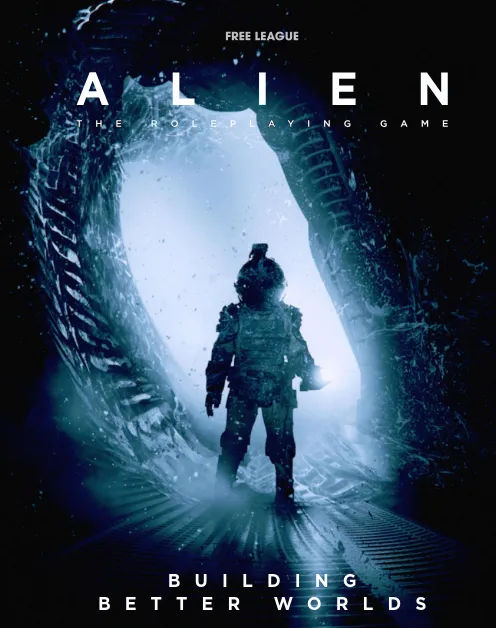
Building Better Worlds was written by Andrew E.C. Gaska and Dave Semark, with illustrations by Martin Grip, Eelco Sebring, and Gustaf Ekelund. It is advertised as a full-scale campaign, with additional material such as new monsters, ships, equipment, and a colony management minigame that can be used to run a sprawling exploration/colonization campaign.
A slight disclaimer: my group did not complete the entirety of the campaign as written, for reasons I will get into later. Even if we had played the entire thing, a 256 page book is beyond the scope of my humble blog. I will focus the review on the ease of getting the chapters of the campaign that we did play to the table, in the order that we played them. That said, it's still going to be longer than my usual post. In fact, it's going to be a multi-part post!
The general premise of the pre-written campaign is that there is a sector of colonized space that has been essentially cut off from the core worlds for about 75 years; thus, a number of "lost colonies" have been fending for themselves for a generation. The PCs are members of an international expedition to make contact with these lost colonies and help bring them back into the fold of civilized space. Naturally, all is not as it seems on many of these worlds, and there is evidence of the Engineers and the technology they left behind that has wreaked havoc on many of the colonies.
The campaign itself is presented as an open-ended sandbox game, with no prescribed path to follow through the six expeditions that all eventually lead to the final confrontation. There are numerous clues to what the book calls the "metapuzzle" that players are meant to uncover in the various expeditions, and then piece together to figure out what's really going on.
In addition to the campaign, there's about 40 pages of lore and setting info at the very start of the book. Me, I would have put this into an appendix and started it with the "Creating Frontier Colonists" section, which sets the tone for the kind of life a PC in this campaign would lead. The information was useful, but it just felt like a lore dump right out of the gate.
Getting it to the Table
To quote Egg Shen from Big Trouble in Little China, "It wasn't easy!". As I've written about before, Free League is great at glossy, pretty pages that have information displayed in a not-quite intuitive way. I had to do a lot of flipping around and re-typing and bullet-pointing to extract the necessary information from the confusing layout in order to be able to run the campaign as the players explored and interacted with different aspects of it. Key bits of information would appear in various places in the chapters, with some details repeated in both the read-aloud text and the informational text (but not always). Compounding this was the fact that since the campaign book was published, the core rules for Alien received an update in the form of the "Evolved Edition"-- thus, any time the campaign book referenced something that was detailed in the core book, it gave a page number that is no longer accurate if you're using the new edition. That's hardly their fault though, so I won't hold it against them.
First Expedition: Leave All Else to the Gods
Elevator Pitch: Pristine, beautiful planet is perfect for colonization, but the disaster that caused the lost colonies to get that way prevented its colonization. Also there's an abandoned Engineer city with sleeping horrors.
At the table, this one felt like a pretty good encapsulation of the grand concept of this campaign; the PCs investigate a planet that's on the list of potential colony sites, then lands to figure out what might have happened. They find strange readings, and upon investigating them they find a massive buried structure that creates some interesting puzzles and obstacles to overcome so they can explore it. My problem with it was that it did feel a lot more like a high-level overview of an adventure site that wasn't quite fleshed out enough. Once they actually got into the ancient Engineer ship that had been buried for thousands of years, there was astonishingly little to do inside other than find the one interactive bit that would yield the metapuzzle clue, which was right next to the room where a xenomorph hive was growing.
This lack of interactivity in the places that are ostensibly meant for exploration would become a recurring issue I had with the campaign as a whole. It felt particularly lacking because my game group includes a lot of players who come from a strong old-school dungeon crawling mentality, and they approached the spaces they were meant to explore as such. It felt like there were a lot of moments where the GM was supposed to describe a big weird sight and then the players were all meant to be awe-struck by what their mind's eye was seeing, but that only gets you so far when you're playing a TTRPG-- I'd much rather have things to do.
This expedition also was a good opportunity to insert the "colony management" mini-game procedure that the book introduces. Overall, I really liked this aspect of the book as it allowed for group discussion and decision making about what projects to enact that would yield different benefits, some of which could even be applied to the "zoomed in" aspects of the campaign. The problem was that it was a complete gear shift, as well as a major shift in time scale. As written, one "cycle" of the colony management game takes up six months of in-game time, which is kind of unrealistic in the context of this campaign, and it would make for a jarring transition between that and the actual on-the-ground exploration of the expeditions. As written, the PCs' ship can travel one parsec in 10 days, and the furthest distance between two colonies detailed in the expeditions I could find is about 7 parsecs. (Interestingly, the map included in the book doesn't actually list all of the worlds that are detailed in the expeditions, making it a rather useless document for play.) Six months of game time is a lot compared to how long it takes the PCs to get from one world to the next, so it just feels like there's no good way to insert colony management using the PCs, unless you made up a new batch of them to do the management and have it run in the background.
That's it for right now. Join me later for the next installment of my review of Building Better Worlds where I'll talk about the other expeditions that we completed and my final thoughts about what worked and what didn't work!